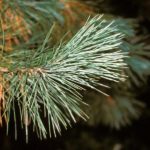
sugar pine (Pinus lambertiana)
Family: Pinaceae
Categories |
Images |
|---|---|
| Form:
This is the largest of all American pines. It usually reaches heights of 175 to 200 ft and a dbh of 3 to 5 ft. |
|
| Needles: Arrangement: 5 per fascicle Length: 2-4″ long Shape: twisted; stouter than white pine Other: blue to gray-green; tend to droop |
Photo Courtesy: Susan McDougall, USDA NRCS Plants Database |
| Bark:
The bark is thin and grayish-green when young. When it matures it becomes thick and reddish-brown with narrow, scaly ridges that are separated by deep furrows. |
|
| Cones:
The cone scales are thicker and more rigid than white pines. Also the cone is very large ranging from 10 to 26″ long and 4 to 5″ in diameter. |
|
| Distinguishing Characteristics:
This species is the largest of the American pines. It has extremely large cones and is found between 4,500 to 5,500 ft. |
|
| Range:
This species grows best on the western slopes of Sierra Nevada Mountains, between 4,500 and 5,500 ft. |
|
| Silvics:
This tree has an intermediate tolerance and is found on cool, moist sites. |
|
| Ecological and Cultural Importance:
The wood is used in molding, windows, door frames, and doors. It is also prone to blister rust and the bark beetle causes damage. White headed woodpeckers and squirrels are know to especially prefer sugar pine as a habitat. |