redwood (Sequoia sempervirens)
Family: Cupressaceae
Categories |
Images |
|---|---|
| Form:
This tree is usually found between 200 and 275 ft. in height and a dbh. of 7 to 12 ft. It has a straight bole with a narrow crown. |
|
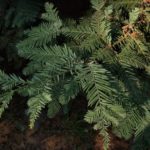
| Needles: Arrangement: 2-ranked Length: 1-2 in. long Shape: flattened Other: 2 stomatal bands below |
Photo Courtesy: Susan McDougall, USDA NRCS Plants Database |
| Bark:
The bark is very thick, often up to 1 ft. thick, and is deeply furrowed with rounded ridges with a reddish to grayish-brown color. |
|
| Cones:
The cones are very small. They are 3/4 to 1″ in length and egg-shaped with reddish-brown color. |
|
| Distinguishing Characteristics:
This is the tallest tree in the world. It has been found at height up to 450 ft. It has a distinctively small, egg-shaped cone, and deeply furrowed bark. |
|
| Range:
This species is restricted to fog belt, that covers a strip of coast from San Francisco Bay to southwestern Oregon. |
|
| Silvics:
This species occurs on mesic soils, alluvial fans and coastal plains. |
|
| Ecological and Cultural Importance:
This is California’s most valuable timber species. It is used in various applications. It provides habitat for the endangered spotted owl and marbled murrelet. |