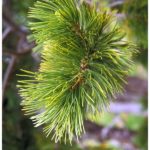
whitebark pine (Pinus albicaulis)
Family: Pinaceae
Categories |
Images |
|---|---|
| Form:
This is a medium sized tree reaching heights of 30 to 50 ft. and a dbh of 1 to 2 ft. It also has a tapering bole. |
|
| Needles: Arrangement: 5 per fascicle; clustered at end of twig Length: 2 – 3″ long Shape: stout; slightly incurved; rigid Other: dark green |
Photo Courtesy: Susan McDougall, USDA NRCS Plants Database |
| Bark:
The bark is thin, smooth, and gray, nearly white, when young. When mature it becomes darker and scaly. |
|
| Cones:
The cones are ovid, serotinous, and brownish-purple in color. |
|
| Distinguishing Characteristics:
Distinguishable from limber pine by its cone. The inner lip of cone scales is purplish-brown and thick, with stout pointed umbos. |
|
| Range:
This species occurs from central Idaho to southeast Wyoming and in the Sierra Nevada mountains of California. |
|
| Silvics:
This tree occurs on dry mountain ridges. |
|
| Ecological and Cultural Importance:
This species is an important source of food for rodents, birds, and bears. It also provides cover for various species of wildlife. |