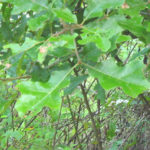
black oak (Quercus velutina)
Family: Fagaceae
Categories |
Images |
|---|---|
| Form:
This tree is medium in size reaching 50 to 60 ft. in height and 2 to 3 ft. in dbh. It also has an irregular crown and a limby bole. |
|
|
Shape: alternate Margin: 5-7 bristle-tipped lobes; sun leaves have deep sinuses and shade leaves have very shallow sinuses Texture: entire Variation: thick; dark green and glabrous above; tomentose beneath |
|
| Bark:
The bark is thick, grayish-black in color and is deeply furrowed vertically with horizontal breaks. The inner bark is orange. |
|
| Twigs and Buds:
The twigs are brown in color, stout and glabrous. The buds are long and sharp with a grayish pubescence. |
[if 483 not_equals=””]
|
| Flowers and Fruit:
The flowers are borne on catkins and are staminate. The fruit is an acorn that is long, ovid and 5/8 to 3/4 inches in length. The cap of the acorn has loose reddish-brown scales. It is also noted the the acorns mature in 2 years. |
|
| Distinguishing Characteristics:
This species has characteristic oak leaves, produced mast every 2 years, and has long terminal buds. |
|
| Range:
This species occurs from Maine to Minnesota, south to eastern Texas and east to Florida. |
|
| Silvics:
This species has an intermediate tolerance and occurs on mesic to dry uplands. |
|