American sycamore (Platanus occidentalis)
Family: Platanaceae
Categories |
Images |
|---|---|
| Form:
One of the tallest eastern species with heights ranging 60 -130 ft. and a 2 – 8 ft. dbh, upper part of bole exfoliates. |
|
|
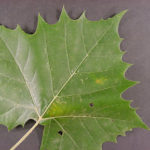
Leaves: Shape: Ovate with 3 -5 lobes Margin: toothed Texture: Veins are pubescent Variation: palmately veined |
|
| Bark:
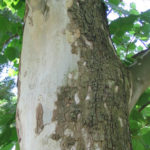
It’s bark is gray-brown and scaly at base and peels extensively, revealing a mottled white to gray-brown upper trunk. |
|
| Twigs and Buds:
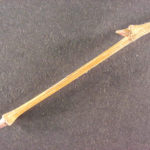
It has a zigzagging twig that is orange-brown in color. The bud is hidden within the petiole base. |
|
| Flowers and Fruit:
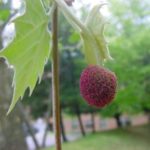
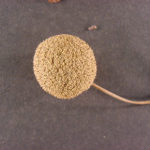
Flowers are not showy. The fruit is an aggregate of achenes arranges in the form of a small golf ball. |
|
| Distinguishing Characteristics:
Look for the exfoliating bark, toothed leaves with 3 lobes, and buds that are partially enclosed. |
|
| Range:
Southwest Maine to eastern Nebraska, south to southeastern Georgia |
|
| Silvics:
It is intolerant of shade and prefers to grow on stream bottoms and low slopes. |
|
| Ecological and Cultural Importance:
Valuable timber species, used for furniture, pulpwood, particle, and fiberboard. Few species of birds and rodents eat the seeds. Also noted as a medium rated habitat for waterfowl. |